|
|
November has been chilly here in Lincolnshire, and as always at this time of year, we’re busy checking on hives as they settle in for winter, and preparing for Christmas! To celebrate the season, we have some fantastic December offers, including smoker and smoker box bundles that would make perfect Christmas gifts.
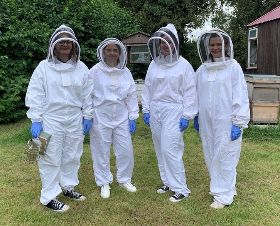
We’re also excited to announce the launch of our Beekeeping Courses here at Thorne, in partnership with Stewart Spinks of Norfolk Honey Company. These courses, starting with beginners' sessions in May and June next year, make great gifts for aspiring beekeepers. Learn more about them below.
|
|
|
|
|
|
|
Our beekeeping courses will take place at our Head Office in Rand, Lincolnshire and will be hosted by Stewart Spinks of Norfolk Honey Company.
|
Having started beekeeping in the 1980s, Stewart has a wealth of beekeeping experience to share and his passion for beekeeping is only equalled by his desire to help new beekeepers make the most from their pastime and enjoy the pleasure of this fabulous hobby.
|
|
|
|
These one day courses will be aimed at the novice beekeeper with no experience, or someone who feels they need to revisit the basics.
|
|
|
|
The cost will be £125, which includes lunch and a £10 voucher to use in our shop. The course will run from 10am to 4pm, with a break for lunch.
|
Day includes:
· A short session in the classroom to introduce the day
· Out into the apiary (weather dependant)
· Final Q&A in classroom
· Chance to look around the shop/factory
· Follow up mentoring
|
|
|
|
|
Subjects covered include:
· Hive types and selecting the right hive
· Smoker use
· A basic inspection
· Spotting the queen
|
|
|
· Understanding Pests and Disease
· Signs of swarming and how to detect them
· Planning your year
· Buying a nucleus colony
· Installing a nucleus colony
|
|
|
|
If these courses are not suitable for you, then we also list courses and events all over the UK on our website. Hosting your own? You can add it to be listed on our website too!
|
|
|
|
|
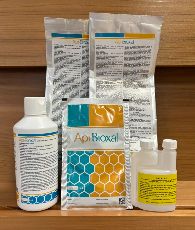
Free Trickle 2 bottle with any ApiBioxal Product!
|
For the rest of December, we are including a free Trickle 2 bottle with any ApiBioxal order. Trickle 2 bottles are incredibly convenient and easy to use, with an accurate dosage everytime.
|
|
|
|
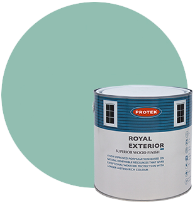
We are offering 15% off all Protek paint until the end of December. While you are carrying out your winter maintenance, why not add a lick of paint to your hives? We have 24 different colours to choose from online.
|
|
|
|
|
15% off Empire Smoker & Smoker Box bundles!
|
You can also enjoy 15% off when you purchase any of our Empire smokers along with one of the smoker boxes. Once you have a smoker and box in your basket, use the code SMOKER15 to add your discount. Read more about these fantastic smoker boxes below in our Equipment Focus...
|
|
|
|
|
|
|
|
|
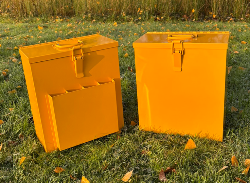
These heavy-duty smoker boxes are a perfect addition to any apiary. Constructed from powder-coated galvanised steel, they feature a secure-fitting lid with a durable fastening clasp. A silicone sealing strip on the lid ensures that no smoke escapes.
|
The smoker box is suitable for most sized smokers. We also have our smoker and tool box that comes with ample room for all your tools, including an additional removable box inside
|
|
|
|
This short video highlights all the fantastic features of these smoker boxes.
|
|
|
|
|
|
|
A short consideration of vegan honey
|
As a non-vegan myself, I admit I had to do a bit of research into the exact definition of the word and whether or not honey was considered vegan-friendly or not. It seemed a bit ambiguous in that while yes, beekeepers can and do remove honey from the hive, bees also pollinate lots of crops that we all eat, vegans included.
|
The Vegan Society website states that vegan food is that which does not come directly from, nor from the exploitation of, an animal. As honeybees are kept in boxes and their honey removed, honey is not considered a vegan food.
|
It may not come as a surprise that this website does not support beekeeping, stating bad beekeeping as one of the major sources of colony losses and in particular disagrees with the harvesting all of the bees’ food (which let’s hope none of us are doing anyway!).
|
As mentioned above, I am not vegan. But I do have a very good friend who is, and she considers honey to be a ‘grey area’. She is happy to purchase honey that she knows is from a beekeeper who takes good care of their bees and what’s more, it is local with low food miles. Interestingly, her partner (also vegan) would never actively buy honey but will eat it once it is in the house. Apparently, the thought process here is that it has already been taken off the hive, jarred and paid for; it would be a waste to now not eat it. So, it would seem even within one vegan household, the attitude towards honey can differ slightly, in a way that eating meat or dairy wouldn’t.
|
The Vegan Society website does offer alternatives to honey, including date syrup and agave syrup. After searching a little more online, I found lots of vegan honey companies using ingredients such as sugarcane juice, brown rice syrup and coconut to replicate the sweet honey taste. Whilst these all sound delicious, I would be interested to hear what people think about these alternatives as they are products that would have to be imported from overseas.
|
What do you think? Do we have any vegan customers that eat honey? What are your thoughts on alternatives to honey?
|
|
|
|
|
|
|
This month here in Lincolnshire we have had a cold snap and some strong winds with lots of rain. Standard November then really! By now, our active beekeeping season is well and truly over, and we are having a break from the daily duties of running two large apiaries. That is not to say, however, that all our jobs are over for the year.
With the weather taking a turn for the worse, one of the jobs is to make sure the hives themselves are intact and good condition to give the bees inside the best chance of surviving the winter. This basically involves walking through the apiary and checking each hive’s stands to make sure the legs are stable, checking for holes in brood bodies, and making sure the roofs are sound with no leaks. Some of the stands could do with being replaced next year when the hives get heavier again but for now, we are happy with the condition of the equipment in the apiaries.
Another job we always do at this time of the year is to check the entrances are clear. With bees dying off, they can often get trapped in the entrance and block the way in and out for other bees and also for ventilation. With a quick heft and a check of the entrance, it is fairly easy to determine if a hive has not survived this first stage of the cold winter months and so any dead-outs are dealt with there and then. These are moved out and equipment put to one side for cleaning.
As mentioned above we have done some hefting, which allows us to make a good estimate as to how much food the bees have still in the hive. We finished the last of the liquid feed a while ago now and we have now moved onto using fondant and protein. This is something we will continue to do throughout the winter to make sure that the bees always have enough to eat.
Next month we will do some varroa monitoring and check to see if and what varroa treatment we might use over the winter. We will also do some consolidating of the outcomes for this year: what went well, what didn’t go so well and make a plan for next year.
|
|
|
|
|
|
|
Big Give Christmas Challenge – Pollinate Change - Please help if you can
|
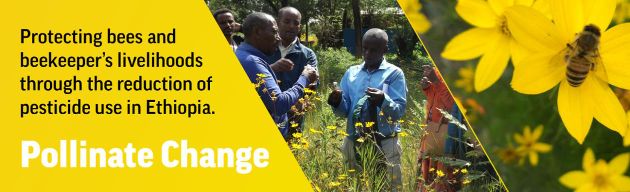
Bees for Development are halfway though there Big Give Christmas Challenge - Honey production is a critical lifeline for Ethiopia’s subsistence farmers, yet they are grappling with a modern catastrophe: the widespread loss of bees due to pesticide use. Molla Adugna lives with his wife and children in Fogera, Ethiopia. To make ends meet he works hard cultivating crops, keeping livestock and he is also a beekeeper. But he soon noticed that as he used more pesticides, his honey bees were dying. “I was causing harm to my bees by applying pesticides on my vegetables. I am to blame. But what can I do? This is the modern way.” Molla Adugna – Molla has now joined Bees for Development’s Farmer Field School programme that educates Ethiopian farmers on sustainable farming practices, boosting populations of ladybirds, spiders, and hoverfly larvae. Natural techniques to control pests empowers farmers like Molla to reduce pesticide use and keep healthy bees for extra income. As a result of this training Bees for Development aim to raise £130,000 to expand their work and with your donations they will train 1,000 Ethiopian farmers to adopt sustainable farming practices. From Tuesday 3 December until midday on Tuesday 10 December all donations to Bees for Development will be doubled by Big Give’s Champions - meaning every donation will be DOUBLED. Please do help if you can – Donate HERE
|
|
|
|
|
|
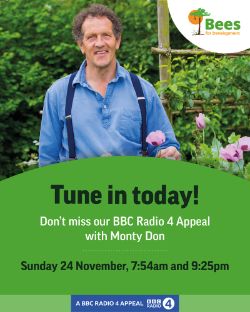
Bees for Development’s BBC Radio 4 Appeal – read by Patron Monty Don
|
If you missed the Bees for Development‘s BBC Radio 4 appeal last week, tune in HERE
Patron and long-time supporter of Bees for Development Monty Don talks about the work that Bees for Development carries out with farmers in Ethiopia, showing them how creating bee-friendly habitats on their farms can boost their income.
The Appeal has now finished – however donations are still being accepted by post (cheques need to be payable to Bees for Development – sent to Freepost BBC Radio 4 Appeal and Bees for Development must be written on the back of the envelope).
|
|
|
|
|
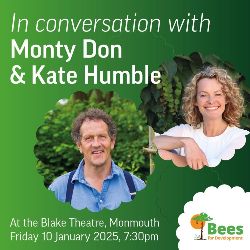
In Conversation with Monty Don & Kate Humble - Bee quick, tickets are selling fast…..
|
|
|
|
Bees for Development are delighted to invite you for an evening of discussion with two of their wonderful Patrons. Join Monty Don and Kate Humble as they discuss all things gardening and farming mixed with their knowledge of sustainable practices and share insights into the work of Bees for Development.
Friday 10 January 2025, doors at 6:30pm for 7:30pm start at The Blake Theatre, Monmouth.
A great Christmas present for Beekeepers and Gardeners alike!
|
|
|
|
|
|
|
|
|
The first couple of lectures from the 2024 National Honey Show have already been released on the show’s YouTube Channel.
|
Nigel Semmence's update since last year on the Asian Hornet (now known as The Yellow Legged Hornet) in the UK can be viewed, as well as Dan Etheridge’s travels and overview of the exotic mite Tropilaelaps, its behaviours and global distribution, including anecdotal, observational findings and what we know so far.
|
|
|
Dan Etheridge’s lecture on the Tropilaelaps mite
|
|
|
|
There will be an additional release over the Christmas break for you to enjoy (Steve Riley’s focus on the hygienic defences that honey bees are deploying against Varroa and how beekeepers can identify, monitor and select for these traits) and more, throughout the year, released on the first Friday of each month at 5.15pm UK local time to revisit from your armchair. Don’t forget to share our Facebook posts that alert to these releases, and ‘subscribe’ to our YouTube Channel. At no cost to you, these are of great help in supporting the show.
|
|
|
|
This year’s ‘live’ videos are still available to watch on the National Honey Show YouTube channel. Don’t forget to ‘Subscribe’ to the channel, it costs nothing and is a great help to the show.
|
|
|
|
We look forward to seeing you at next year’s show:
National Honey Show Thursday 23rd to Saturday 25th October 2025 at Sandown Park Racecourse, Esher, Surrey, KT10 9RT, UK.
|
|
|
|
|
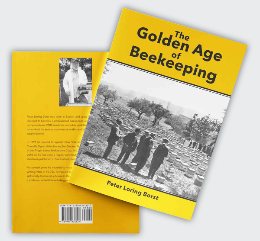
The Golden Age of Beekeeping
By Peter Loring Borst
|
|
|
|
"The story behind the revolution of American Beekeeping, an important book for beekeepers interested in beekeeping history"
|
Northern Bee Books
(1st ed. 2024)
Paperback
240 pages
£28
|
|
|
|
|
The Golden Age of Beekeeping is a fascinating history of beekeeping in the USA from the early pioneering days to the modern beekeeping world of the 20th Century. Author Peter Borst has done a thorough job of researching and selecting detailed information, and presenting it in a very readable way. Borst has had a long professional career in beekeeping, and contributes to various beekeeping journals, including the American Bee Journal, on a regular basis. Some of this work has already been published separately in magazine articles, but they have been seamlessly woven into this history to flow fluently as a story of the development of beekeeping primarily in the US, but Borst touches briefly on Central and South American beekeeping.
|
There are 21 chapters with a useful reference list at the end of each one. Throughout the book there are old photographs, advertisements, newspaper articles, and quotations from famous beekeepers to give substance to the stories.
|
We learn how the early settlers obtained honey from chopping down bee trees before they started managing bees in straw skeps. There is a chapter on Langstroth who was one of the most influential beekeepers in American history at a time when new inventions were gathering momentum and the patent wars began. As beekeepers moved away from skep beekeeping, designing the ideal hive was key and many different types were invented and tried out in those early days. The Harbison hive, for example, was designed with a back opening similar to the Slovenian hives of today.
|
The Harbison brothers were the real entrepreneurs of their day, which was the Californian gold rush days of 1848-49. They knew that most of the real money to be made was by supplying provisions etc to the gold prospectors and diggers. So, they move south to California. They revolutionised honey by using extractors and producing liquid honey which quickly gained popularity over comb honey. They shipped train-loads of sage honey back East and influenced agriculture in the fertile Central Valley of California. Farmers at the time lacked knowledge around pollination and thought that honey bees were bad for their crops. It is intriguing to consider how beekeeping influenced both social change and agriculture.
|
Every aspect of beekeeping history is explored from the early scientific discoveries of the late 1800’s, with contributions from Riley and Benton, to the literature and development of journals and conferences to share early science-based information.
|
Did you know that large scale beekeeping was first practiced by the early Egyptians? We discover how the new motorised vehicle designs of the early 1900’s facilitated moving bees on a large scale and contributed to the development of commercial beekeeping in the US.
|
Women beekeepers feature in this beekeeping history. We read about colourful characters such as Ellen Tupper who was a great champion for women in beekeeping though not always accurate in her facts, and prone to making false claims.
|
The Golden Age of Beekeeping should be on the recommended reading list of every Master Beekeeper Course in the US. It is an important book for beekeepers interested in the heritage of their vocation, or avocation, especially those in the US. However, anyone interested in beekeeping and history will enjoy it as it provides a marvellous insight into our past, and how we arrived at the present state of beekeeping in the 21st Century.
|
|
|
|
|
|
|
|
|
There will be plenty of other great offers. These items will be available for home delivery. We will be offering free delivery on all sale orders over £100 to Great Britain, and over £150 to Northern Ireland.
|
|
|
|
|
|
|
|